
Cricket (insect)
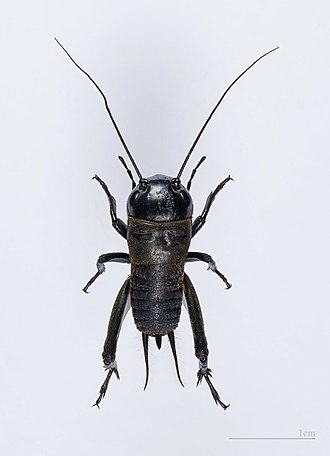
Crickets are Orthopteran insects which are related to bush crickets, and, more distantly, to grasshoppers. In older literature, such as Imms,[3] “crickets” were placed at the family level (i.e. Gryllidae), but contemporary authorities including Otte now place them in the superfamily Grylloidea.[1] The word has been used in combination to describe more distantly related taxa[3] in the suborder Ensifera, such as king crickets and mole crickets.
They have mainly cylindricaly-shaped bodies, round heads, and long antennae. Behind the head is a smooth, robust pronotum. The abdomen ends in a pair of long cerci; females have a long, cylindrical ovipositor. Diagnostic features include legs with 3-segmented tarsi; as with many Orthoptera, the hind legs have enlarged femora, providing power for jumping. The front wings are adapted as tough, leathery elytra, and some crickets chirp by rubbing parts of these together. The hind wings are membranous and folded when not in use for flight; many species, however, are flightless. The largest members of the family are the bull crickets, Brachytrupes, which are up to 5 cm (2 in) long.
Crickets are distributed all around the world except at latitudes 55° or higher, with the greatest diversity being in the tropics. They occur in varied habitats from grassland, bushes, and forests to marshes, beaches, and caves. Crickets are mainly nocturnal, and are best known for the loud, persistent, chirping song of males trying to attract females, although some species are mute. The singing species have good hearing, via the tympana on the tibiae of the front legs.
Crickets often appear as characters in literature. The Talking Cricket features in Carlo Collodi’s 1883 children’s book, The Adventures of Pinocchio, and in films based on the book. The insect is central to Charles Dickens’s 1845 The Cricket on the Hearth and George Selden’s 1960 The Cricket in Times Square. Crickets are celebrated in poems by William Wordsworth, John Keats, and Du Fu. They are kept as pets in countries from China to Europe, sometimes for cricket fighting. Crickets are efficient at converting their food into body mass, making them a candidate for food production. They are used as human food in Southeast Asia, where they are sold deep-fried in markets as snacks. They are also used to feed carnivorous pets and zoo animals. In Brazilian folklore, crickets feature as omens of various events.
Crickets are small to medium-sized insects with mostly cylindrical, somewhat vertically flattened bodies. The head is spherical with long slender antennae arising from cone-shaped scapes (first segments) and just behind these are two large compound eyes. On the forehead are three ocelli (simple eyes). The pronotum (first thoracic segment) is trapezoidal in shape, robust, and well-sclerotinized. It is smooth and has neither dorsal nor lateral keels (ridges).[4]
At the tip of the abdomen is a pair of long cerci (paired appendages on rearmost segment), and in females, the ovipositor is cylindrical, long and narrow, smooth and shiny. The femora (third segments) of the back pair of legs are greatly enlarged for jumping. The tibiae (fourth segments) of the hind legs are armed with a number of moveable spurs, the arrangement of which is characteristic of each species. The tibiae of the front legs bear one or more tympani which are used for the reception of sound.[4]
The wings lie flat on the body and are very variable in size between species, being reduced in size in some crickets and missing in others. The fore wings are elytra made of tough chitin, acting as a protective shield for the soft parts of the body and in males, bear the stridulatory organs for the production of sound. The hind pair is membranous, folding fan-wise under the fore wings. In many species, the wings are not adapted for flight.[1]
The largest members of the family are the 5 cm (2 in)-long bull crickets (Brachytrupes) which excavate burrows a metre or more deep. The tree crickets (Oecanthinae) are delicate white or pale green insects with transparent fore wings, while the field crickets (Gryllinae) are robust brown or black insects.[1]
