
Parmigiano-Reggiano
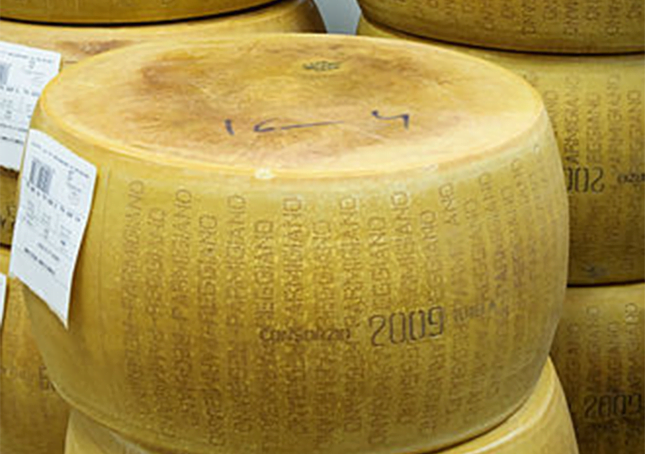
Parmigiano-Reggiano (/ˌpɑːrmɪˈdʒɑːnoʊ rɛˈdʒɑːnoʊ/, Italian: [parmiˈdʒaːno redˈdʒaːno]) is an Italian hard, granular cheese produced from cow’s milk and aged at least 12 months.
Parmigiano-Reggiano
It is named after the producing areas, the provinces of Reggio Emilia, Parma, the part of Bologna west of the Reno, and Modena (all in Emilia-Romagna); and the part of Mantua (Lombardy) on the right/south bank of the Po. Parmigiano is the Italian adjective for Parma and Reggiano that for Reggio Emilia.
Both “Parmigiano-Reggiano” and “Parmesan” are protected designations of origin (PDO) for cheeses produced in these provinces under Italian and European law.[1] Outside the EU, the name “Parmesan” can legally be used for similar cheeses, with only the full Italian name unambiguously referring to PDO Parmigiano-Reggiano.
It has been called the “King of Cheeses” and a “practically perfect food”.
Parmigiano-Reggiano is made from unpasteurised cow’s milk. The whole milk of the morning milking is mixed with the naturally skimmed milk (which is made by keeping milk in large shallow tanks to allow the cream to separate) of the previous evening’s milking, resulting in a part skim mixture. This mixture is pumped into copper-lined vats, which heat evenly and contribute copper ions to the mix.
The cheese is put into a stainless steel, round form that is pulled tight with a spring-powered buckle so the cheese retains its wheel shape. After a day or two, the buckle is released and a plastic belt imprinted numerous times with the Parmigiano-Reggiano name, the plant’s number, and month and year of production is put around the cheese and the metal form is buckled tight again.
The imprints take hold on the rind of the cheese in about a day and the wheel is then put into a brine bath to absorb salt for 20–25 days. After brining, the wheels are then transferred to the aging rooms in the plant for 12 months. Each cheese is placed on wooden shelves that can be 24 cheeses high by 90 cheeses long or 2160 total wheels per aisle. Each cheese and the shelf underneath it is then cleaned manually or robotically every seven days. The cheese is also turned at this time.
