
Bacillus cereus
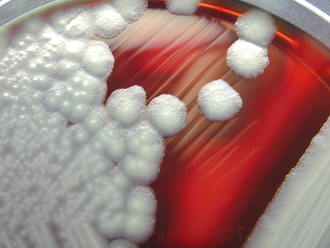
Bacillus cereus is a Gram-positive, rod-shaped, facultatively anaerobic, motile, beta-hemolytic, spore-forming bacterium commonly found in soil, food and marine sponges.[1] The specific name, cereus, meaning “waxy” in Latin, refers to the appearance of colonies grown on blood agar. Some strains are harmful to humans and cause foodborne illness, while other strains can be beneficial as probiotics for animals.[2][3] The bacteria is classically contracted from fried rice dishes that have been sitting at room temperature for hours.[4][5] B. cereus bacteria are facultative anaerobes, and like other members of the genus Bacillus, can produce protective endospores. Its virulence factors include phospholipase C, cereulide, sphingomyelinase, metalloproteases, and cytotoxin K.[6]
The Bacillus cereus group comprises seven closely related species: B. cereus sensu stricto (referred to herein as B. cereus), B. anthracis, B. thuringiensis, B. mycoides, B. pseudomycoides, and B. cytotoxicus;[7] or as six species in a Bacillus cereus sensu lato: B. weihenstephanensis, B. mycoides, B. pseudomycoides, B. cereus, B. thuringiensis, and B. anthracis.[8]
Like most Bacilli, the most common ecosystem of Bacillus cereus is land. In concert with Arbuscular mycorrhiza (and Rhizobium leguminosarum in clover), they can regenerate heavy metal soil by increasing phosphorus, nitrogen, and potassium content in certain plants.[9]
B. cereus competes with other microorganisms such as Salmonella and Campylobacter in the gut; its presence reduces the numbers of those microorganisms. In food animals such as chickens,[10] rabbits[11] and pigs,[12] some harmless strains of B. cereus are used as a probiotic feed additive to reduce Salmonella in the animals’ intestines and cecum. This improves the animals’ growth, as well as food safety for humans who eat them. B. cereus can parasitize codling moth larvae.[citation needed]
B. cereus and other members of Bacillus are not easily killed by alcohol; they have been known to colonize distilled liquors and alcohol-soaked swabs and pads in numbers sufficient to cause infection.[13][14]
