
Viridans streptococci
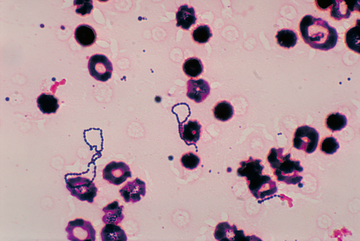
The viridans streptococci are a large group of commensal streptococcal Gram-positive bacteria species that are α-hemolytic, producing a green coloration on blood agar plates (hence the name “viridans”, from Latin “vĭrĭdis”, green), although some species in this group are actually γ-hemolytic, meaning they produce no change on blood agar.[1] The pseudo-taxonomic term “Streptococcus viridans” is often used to refer to this group of species, but writers who do not like to use the pseudotaxonomic term (which treats a group of species as if they were one species) prefer the terms viridans streptococci,[2] viridans group streptococci (VGS), or viridans streptococcal species.
These species possess no Lancefield antigens.[3] In general, pathogenicity is low.[4]
Phenotypic and biochemical identification
Identification of VGS to the species level can be difficult, and phenotypic identification is not always accurate. The name “viridans” is somewhat of a misnomer, as many species do not produce any hemolysis on blood agar. From a classification perspective, it is not useful to try to differentiate alpha-hemolysis from a lack of hemolysis on blood agar plates (sometimes referred to as “gamma-hemolysis”); this feature can vary widely with the growth medium used to cultivate the organism, as well as the incubation temperature. Lack of alpha hemolysis does not seem to correlate with the clinical outcome or severity of disease; no enzymatic or toxigenic effect has ever been documented as a by-product of alpha hemolysis.
Under the microscope, bacteria from the viridans group are gram-positive cocci in chains. They do not express catalase and so are catalase-negative.[7] They are leucine aminopeptidase positive, pyrrolidonylarylamidase negative, and do not grow in 6.5% NaCl, and almost all species are negative for growth on bile esculin agar. They differ from pneumococci in that they are optochin resistant and are not bile soluble. However, Richter et al. examined misidentification of VGS submitted to antimicrobial surveillance programs as pneumococci and found that the distinction of S. pneumoniae from the VGS can be difficult, which is not surprising in light of the fact that S. mitis and S. oralis possess >99% sequence homology with S. pneumoniae (47). The authors also found that optochin disk testing did not perform as well as bile solubility testing for identification; in a survey of 1,733 isolates tested, bile solubility testing had higher sensitivity and specificity for differentiation of VGS from pneumococci (47).
S. anginosus group The S. anginosus group of organisms can be beta-, alpha- or nonhemolytic. The isolates lacking beta-hemolysis are generally those grouped with the VGS. S. constellatus is the most likely of this group to be beta-hemolytic. There is some evidence implicating beta-hemolytic S. constellatus subsp. pharyngis as a cause of pharyngitis (55). S. intermedius is the species in this group most commonly isolated from brain and liver abscesses. The S. anginosus group can possess Lancefield group antigens A, C, G, and F, although S. intermedius almost never possesses Lancefield group antigens. Isolates of the S. anginosus group have a characteristic “butterscotch” odor. Members of the group are universally positive for three biochemical reactions: acetoin production from glucose (positive Vogues–Proskauer reaction), arginine, and sorbitol. These are very useful for the differentiation of this group from other VGS.
S. mitis group. The S. mitis group of organisms contains several species and is biochemically very inert, which can make species level identification very challenging. The use of invalid species names has also been a particular problem with the S. mitis group. Isolates in this group are negative for acetoin production, arginine, esculin, and mannitol and are sorbitol fermentation negative (14). S. pneumoniae is a recently characterized member of the S. mitis group (1). As the organism is closely related to S. pneumoniae and other S. mitis group organisms, accurate identification can be difficult. S. pseudopneumoniae lacks the pneumococcal capsule and is resistant to optochin when incubated in an atmosphere with elevated CO2 but is susceptible when incubated in ambient air. Bile solubility is a more specific test for S. pseudopneumoniae than optochin susceptibility, as the organism is not bile soluble (1).
