
Chicago school (architecture)
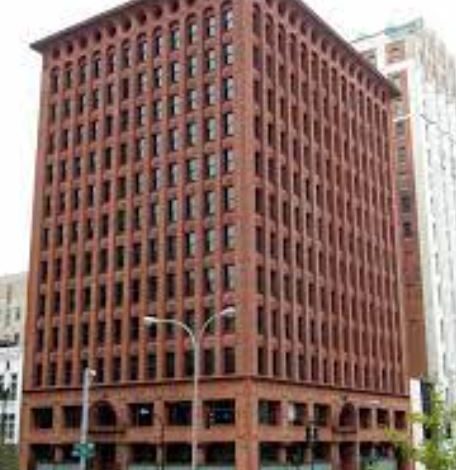
While the term “Chicago School” is widely used to describe buildings constructed in the city during the 1880s and 1890s, this term has been disputed by scholars, in particular in reaction to Carl Condit’s 1952 book The Chicago School of Architecture. Historians such as H. Allen Brooks, Winston Weisman and Daniel Bluestone have pointed out that the phrase suggests a unified set of aesthetic or conceptual precepts, when, in fact, Chicago buildings of the era displayed a wide variety of styles and techniques. Contemporary publications used the phrase “Commercial Style” to describe the innovative tall buildings of the era, rather than proposing any sort of unified “school.”
A steel skeletal frame, like that of the Fisher Building (1895-1896), meant the height of a building was no longer limited by the strength of its walls.
Some of the distinguishing features of the Chicago School are the use of steel-frame buildings with masonry cladding (usually terra cotta), allowing large plate-glass window areas and limiting the amount of exterior ornamentation. Sometimes elements of neoclassical architecture are used in Chicago School skyscrapers. Many Chicago School skyscrapers contain the three parts of a classical column. The lowest floors functions as the base, the middle stories, usually with little ornamental detail, act as the shaft of the column, and the last floor or two, often capped with a cornice and often with more ornamental detail, represent the capital.
