
House dust mite
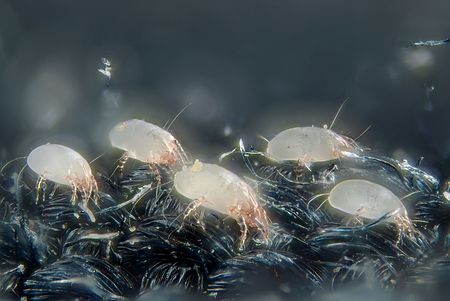
House dust mites (HDM, or simply dust mites) are mites found in association with dust in dwellings.[1] They are known for causing an allergy.
The dust mites are cosmopolitan members of the mite family Pyroglyphidae.
House dust mites, due to their very small size and translucent bodies, are barely visible to the unaided eye.[3] A typical house dust mite measures 0.2–0.3 mm in length.[4] The body of the house dust mite has a striated cuticle.
They feed on skin flakes from humans and other animals, and on some mold. Dermatophagoides farinae fungal food choices in 16 tested species commonly found in homes was observed in vitro to be Alternaria alternata, Cladosporium sphaerospermum, and Wallemia sebi, and they disliked Penicillium chrysogenum, Aspergillus versicolor, and Stachybotrys chartarum.[5]
The predators of dust mites are other allergenic mites (Cheyletiella), silverfish and pseudoscorpions.[6]
The average life cycle for a house dust mite is 65–100 days.[7] A mated female house dust mite can live up to 70 days, laying 60 to 100 eggs in the last five weeks of her life. In a 10-week life span, a house dust mite will produce approximately 2,000 fecal particles and an even larger number of partially digested enzyme-covered dust particles.
Dust mites are found worldwide, but are found more commonly in humid regions.[8] The species Blomia tropicalis is typically found only in tropical or subtropical regions.[9] Detectable dust mite allergen was found in the beds of about 84% of surveyed United States homes.[10] In Europe, detectable Der p 1 or Der f 1 allergen was found in 68% of surveyed homes.[11]
House dust mites are present indoors wherever humans live. Positive tests for dust mite allergies are extremely common among people with asthma. Dust mites are microscopic arachnids whose primary food is dead human skin cells, but they do not live on living people. They and their feces and other allergens that they produce are major constituents of house dust, but because they are so heavy they are not suspended for long in the air. They are generally found on the floor and other surfaces, until disturbed (by walking, for example). It could take somewhere between twenty minutes and two hours for dust mites to settle back down out of the air.
Dust mites are a nesting species that prefers a dark, warm, and humid climate. They flourish in mattresses, bedding, upholstered furniture, and carpets.[16] Their feces include enzymes that are released upon contact with a moist surface, which can happen when a person inhales, and these enzymes can kill cells within the human body.[17] House dust mites did not become a problem until humans began to use textiles, such as western style blankets and clothing.[18]
Allergy patients are advised to keep the relative humidity below 50%, if possible. Very few mites can survive if the humidity is less than 45% (at 22 °C (72 °F)). However, they can survive if the humidity is high just for an hour and a half per day, for example due to moisture released to the air when cooking food.[21]
