
Jojoba
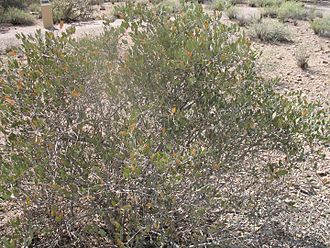
Jojoba /həˈhoʊbə/ (About this soundlisten), with the botanical name Simmondsia chinensis, and also known as goat nut, deer nut, pignut, wild hazel, quinine nut, coffeeberry, and gray box bush,[2] is native to the Southwestern United States. Simmondsia chinensis is the sole species of the family Simmondsiaceae, placed in the order Caryophyllales.
Jojoba is grown commercially to produce jojoba oil, a liquid wax ester extracted from its seed.
The plant is a native shrub of the Sonoran Desert,[3] Colorado Desert, Baja California Desert, and California chaparral and woodlands habitats in the Peninsular Ranges and San Jacinto Mountains. It is found in southern California, Arizona, and Utah (U.S.), and Baja California state (Mexico).
Jojoba is endemic to North America, and occupies an area of approximately 260,000 square kilometers (100,000 sq mi) between latitudes 25° and 31° North and between longitudes 109° and 117° West.[3]
Description
Simmondsia chinensis, or jojoba, typically grows to 1–2 meters (3.3–6.6 ft) tall, with a broad, dense crown, but there have been reports of plants as tall as 3 meters (9.8 ft).[3]
The leaves are opposite, oval in shape, 2–4 centimeters (0.79–1.57 in) long and 1.5–3 centimeters (0.59–1.18 in) broad, thick, waxy, and glaucous gray-green in color.
The flowers are small and greenish-yellow, with 5–6 sepals and no petals. The plant typically blooms from March to May.[4]
Reproduction
Each plant is dioecious, with hermaphrodites being extremely rare. The fruit is an acorn-shaped ovoid, three-angled capsule 1–2 centimeters (0.39–0.79 in) long, partly enclosed at the base by the sepals. The mature seed is a hard oval that is dark brown and contains an oil (liquid wax) content of approximately 54%. An average-sized bush produces 1 kilogram (2.2 lb) of pollen, to which few humans are allergic.[2]
The female plants produce seed from flowers pollinated by the male plants. Jojoba leaves have an aerodynamic shape, creating a spiral effect, which brings wind-born pollen from the male flower to the female flower. In the Northern Hemisphere, pollination occurs during February and March. In the Southern Hemisphere, pollination occurs during August and September.
