
Sassafras
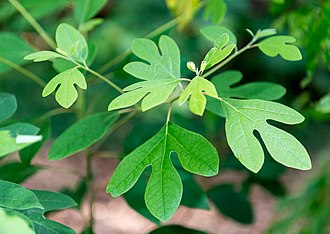
Sassafras is a genus of three extant and one extinct species of deciduous trees in the family Lauraceae, native to eastern North America and eastern Asia.[2][3][4] The genus is distinguished by its aromatic properties, which have made the tree useful to humans.
Sassafras trees grow from 9–35 m (30–115 ft) tall with many slender sympodial branches, and smooth, orange-brown bark or yellow bark.[5] All parts of the plants are fragrant. The species are unusual in having three distinct leaf patterns on the same plant: unlobed oval, bilobed (mitten-shaped), and trilobed (three-pronged); the leaves are hardly ever five-lobed.[6] Three-lobed leaves are more common in Sassafras tzumu and Sassafras randaiense than in their North American counterparts, although three-lobed leaves do sometimes occur on Sassafras albidum. The young leaves and twigs are quite mucilaginous, and produce a citrus-like scent when crushed. The tiny, yellow flowers are generally six-petaled; Sassafras albidum and Sassafras hesperia are dioecious, with male and female flowers on separate trees, while Sassafras tzumu and Sassafras randaiense have male and female flowers occurring on the same trees. The fruit is a drupe, blue-black when ripe.[2]
The genus Sassafras was first described by the Bohemian botanist Jan Presl in 1825.[1] The name “sassafras”, applied by the botanist Nicolas Monardes in 1569, comes from the French sassafras. Some sources claim it originates from the Latin saxifraga or saxifragus: “stone-breaking”; saxum “rock” + frangere “to break”).[9][10] Sassafras trees are not within the family Saxifragaceae.[citation needed]
Early European colonists reported that the plant was called winauk by Native Americans in Delaware and Virginia and pauane by the Timucua. Native Americans distinguished between white sassafras and red sassafras, terms which referred to different parts of the same plant but with distinct colors and uses.[11] Sassafras was known as fennel wood (German Fenchelholz) due to its distinctive aroma.[12][clarification needed]
