
Ruscus
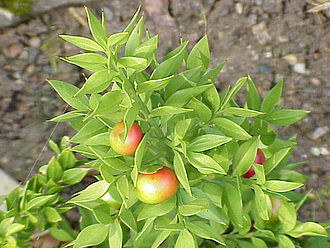
Ruscus is a genus of six species of flowering plants, native to western and southern Europe (including northern to southern England), Macaronesia, northwestern Africa, and southwestern Asia east to the Caucasus.[1] In the APG III classification system, it is placed in the family Asparagaceae, subfamily Nolinoideae (formerly the family Ruscaceae).[2] Like many lilioid monocots, it was formerly classified in the family Liliaceae.
The species are evergreen shrub-like perennial plants, growing to approximately 1 metre (3 ft 3 in) tall. They have branched stems that bear numerous cladodes (flattened, leaf-like stem tissue, also known as phylloclades) 2 to 18 centimetres (0.79 to 7.09 in) long and 1 to 8 centimetres (0.39 to 3.15 in) broad. The true leaves are minute, scale-like, and non-photosynthetic. The flowers are small, white with a dark-violet centre, and situated on the middle of the cladodes. The fruit is a red berry 5 to 10 millimetres (0.20 to 0.39 in) in diameter. Some species are monoecious while others are dioecious.
Ruscus is spread by seed and by means of underground rhizomes. It can colonise extensive patches of ground.
