
Rudbeckia
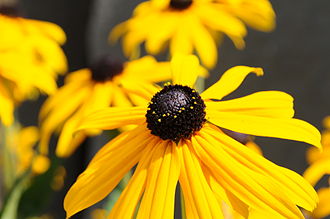
Rudbeckia /rʌdˈbɛkiə/[4] is a plant genus in the Asteraceae or composite family.[5][6] Rudbeckia flowers feature a prominent, raised central disc in black, brown shades of green, and in-between tones, giving rise to their familiar common names of coneflowers and black-eyed-susans. All are native to North America, and many species are cultivated in gardens for their showy yellow or gold flower heads that bloom in mid to late summer.
The species are herbaceous, mostly perennial plants (some annual or biennial) growing to 0.5–3.0 m tall, with simple or branched stems. The leaves are spirally arranged, entire to deeply lobed, and 5–25 cm long. The flowers are produced in daisy-like inflorescences, with yellow or orange florets arranged in a prominent, cone-shaped head; “cone-shaped” because the ray florets tend to point out and down (are decumbent) as the flower head opens.
A large number of species have been proposed within Rudbeckia, but most are now regarded as synonyms of the limited list given below.
Several currently accepted species have several accepted varieties. Some of them (for example the black-eyed susan, R. hirta), are popular garden flowers distinguished for their long flowering times. Many cultivars of these species are known.
Rudbeckia is one of at least four genera within the flowering plant family Asteraceae whose members are commonly known as coneflowers; the others are Echinacea, Dracopis, and Ratibida.
Rudbeckia species are eaten by the caterpillars of some Lepidoptera species including cabbage moths and dot moths.
