
Silybum
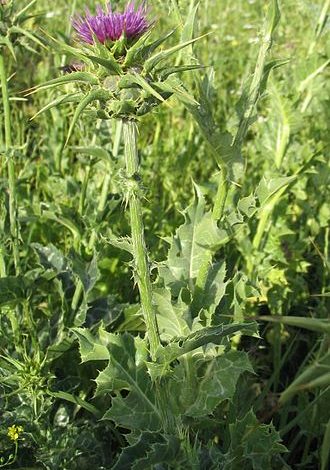
Silybum (milk thistle) is a genus of two species of thistles in the daisy family.[1][3] The plants are native to the Mediterranean regions of Europe,[4] North Africa, and the Middle East. One species has been introduced elsewhere, including in North America.[5] The name “milk thistle” derives from a feature of the leaves, which are prominently banded with splashes of white. Historically, these milky bands were said to be Mother Mary’s milk, and this is the origin of another common name, St. Mary’s thistle. The most widespread species is Silybum marianum.[6]
Claims have been made since ancient times[when?][where?] that the active flavanoid-lignan (flavanolignan) group of constituents, called silymarin, contained only in the seed shell has liver-protective and regenerative properties, as well as antioxidant effects. Chemical, pharmacological, and safety research started in Germany in the 1950s[citation needed]. In 2007, a Cochrane review of the research literature found that in clinical trials using high-quality methods, there was no significant medical improvement from milk thistle for patients with alcoholic or Hepatitis B or C liver disease.[7]
Members of this genus grow as annual or biennial plants. The erect stem is tall, branched and furrowed but not spiny. The large, alternate leaves are waxy-lobed, toothed and thorny, as in other genera of thistle. The lower leaves are sessile (attached to the stem without petiole). The upper leaves have a clasping base. They have large, disc-shaped pink-to-purple, rarely white, solitary flower heads at the end of the stem. The flowers consist of tubular florets. The phyllaries under the flowers occur in many rows, with the outer row with spine-tipped lobes and apical spines. The fruit is a black achene with a white pappus.[8]
Silybum marianum is by far the more widely known species. Milk thistle is believed to give some remedy for liver diseases (e.g. viral hepatitis) and the extract, silymarin, is used in medicine. Mild gastrointestinal distress is the most common adverse event reported for milk thistle. The incidence is the same as for placebo.[11] A laxative effect for milk thistle has also been reported infrequently.[12]
