
Sabal
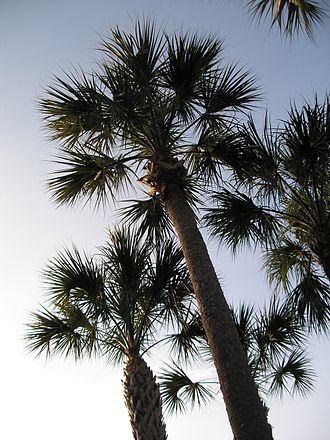
Sabal is a genus of palms (or fan-palms) endemic to the New World. Currently, there are 17 recognized species of Sabal, including one hybrid species.[4] The species are native to the subtropical and tropical regions of the Americas, from the Gulf Coast/South Atlantic states in the Southeastern United States, south through the Caribbean, Mexico, and Central America to Colombia and Venezuela. Members of this genus are typically identified by the leaves which originate from a bare, unarmed petiole in a fan-like structure. All members of this genus have a costa (or midrib) that extends into the leaf blade. This midrib can vary in length; and it is due to this variation that leaf blades of certain species of Sabal are strongly curved or strongly costapalmate (as in Sabal palmetto and Sabal etonia) or weakly curved (almost flattened), weakly costapalmate, (as in Sabal minor). Like many other palms, the fruit of Sabal are drupe, that typically change from green to black when mature.
The name Sabal was first applied to members of the group by Michel Adanson in the 18th century.[12] Previous names that this genus was associated with include Corypha, Chamaerops, Rhapis.[13][12] This section highlights important phylogenetic work done within the genus Sabal.
In 1990, Scott Zona outlined key morphological and anatomical characters that he used to analyze species relationships of Sabal. Through this analysis of characters, Zona produced a cladogram that portrays evolutionary relationships amongst 15 species of Sabal.[13] Based on the distribution of species within his cladogram, Zona recognized four distinct clades.[13] The clades within his study include (Clade 1) Sabal minor; (Clade 2) Sabal bermudana, Sabal palmetto, Sabal miamiensis, and Sabal etonia; (Clade 3) Sabal maritima, Sabal domingensis, Sabal causiarum, Sabal maurittiformis, Sabal yapa, Sabal mexicana, and Sabal guatemalensis; (Clade 4) Sabal uresana, Sabal rosei, and Sabal pumos.[13] These clades associate closely with geographic distributions.[13] All of the species within Clade 3 occur in the Greater Antilles and southern Mexico, where species that occur in the Greater Antilles are more closely related to each other than those that occur in southern Mexico.[13] Although Clade 4 also occurs in Mexico, these species occur on the west coast where they are geographically separated from the Mexican species within the southern part of the country.[13] The remaining two clades, Clade 1 and Clade 2 predominantly occur in the southeastern United States although S. palmetto and S. minor are also known from Cuba and the Bahamas (S. palmetto) and northern Mexico (S. minor).[13] Sabal bermudana is only known from the Bermuda Islands.[13]
In 2016 Heyduk, Trapnell, Barrett, and Leebens-Mack conducted a new study on Sabal that analyzed molecular (e.g. nuclear, plastid) data from 15 species of the group.[14] This study incorporated plastid and nuclear sequence data that together were used to estimate the relatedness between the species of Sabal.[14] The results of the study show species relationships to be different from the distribution of Zona’s cladogram.[13][14] Within the framework of this study, a major difference between the results of Zona and this study is the placement of “Clade 4” (Sabal uresana, Sabal rosei, and Sabal pumos) which split and integrate these species throughout the phylogeny of Sabal.[13][14] The largest of the clades identified by Zona, “Clade 3” is disrupted significantly as it is split into multiple clades.[13][14] Although Sabal causiarum and S. domingensis retain their relationship as sister species, they are included in a clade that also includes S. maritima and S. rosei.[13][14] Despite these disruptions in placement between these two studies, the overall integrity of “Clade 1” and “Clade 2” is in congruence with the clades established from the molecular data.[14][13]
